

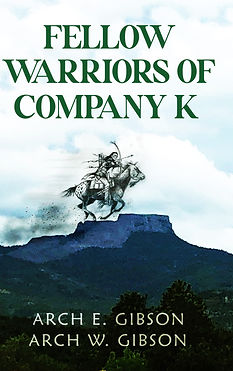
Fellow Warriors of Company K
From Fierce Foes to Fellow Warriors
Disillusioned U.S. Cavalry Major Sam Nabors hopes to retire when he is called to Fort Leavenworth in the post-Civil War West. Guilt-ridden after the murder of his family on their Silver Creek farm in Kansas, Nabors is promoted to colonel and convinced by General Andy Chutte that he is one of few who can lead a mission to retrieve an abandoned cache of gold…before disaffected Confederate marauders steal it to finance a new war. Nabors grudgingly accepts, buying time to resolve his grief and please the general.
Nabors is joined by an unlikely match of Union and Southern officers, the famed all-black Buffalo Soldiers, Comanche and Osage, and remarkable emancipated women of the period. Too late, a supposedly loyal officer is linked to his family’s death…and a whole lot more. A trail of blood and betrayal ensues from New Mexico territory to Silver Creek before Nabors and fellow warriors extract the long-delayed revenge and Nabors can hang up his spurs for good.
Fellow Warriors of Company K
Chapter 1
Silver Creek in Southeast Kansas
I eased my creaky chair back on the rock patio, careful not to upset my balance and return to my haunting thoughts. I stared at the full moon. It hung over winter-bare limbs of burr oak, sycamore and redbud on the far hillside. The yellowed tallgrass shimmered in a chilling wind. It stretched around the Flint Hills and disappeared in the dark. Southeast Kansas Territory. A shrinking refuge flooded by post-Civil War migration and my guilt-ridden memories.
Self-incrimination constantly smothered my pride in building and rebuilding the growing string of U.S. Army forts that penetrated the western frontier. They protected the unending migration of settlers, prospectors, fortune seekers and schemers. The growing Comanche, Kiowa, Cheyenne, and Arapahoe defiance were more causes for concern. White demands on the frontier were simple: More soldiers and less tolerance.
My farm and surrounding lands had been Osage land until a few short years ago. The entire tribe moved to land it bought in Indian Territory under a treaty agreement. Its Kansas land was opened to settlement, and I was able to buy the 160 acres for $1.25 an acre. I had crossed it many times enroute to the forts in Indian Territory and knew it would make rich farmland. Thousands of settlers ahead of me with more coming.
Now the Osage were my neighbors in adjoining Indian Territory. They were friends, as were Comanche, Kiowa and others employed by the Army. They served as scouts, hunters and intermediaries with tribal holdouts who still roamed the plains.
My Indian friends all gave me hope that we someday could live side by side in peace. My family loved the arrangement, and we built a small two-room cabin, barn and corrals above Silver Creek. I moved a small herd of Herefords onto the lush land. The Osage and Kaw became strong friends. They eagerly helped the women tend the herd, plant crops and harvest during my extended absences. Kansas had become more peaceful after its bloody years before and during the war.
Doc Braddock, my Army surgeon, labeled my lingering war wounds and stress as “homesickness” and “nostalgia”. Whatever we called it, thousands of fellow warriors wasted away from it. Most of us talked among ourselves in Private, bitter solace. We blamed an uncaring government and public consumed by what Senator Benton of Missouri defended as manifest destiny. And some of us developed the habit of talking to ourselves…in unending second guessing and self-incrimination.
Fancy words for greed and guilt Mister Nabors. You go ahead and shelter here. Make you feel better…But people don’t seem to change...ever. I grew comfortable with those accusing thoughts. I could smell and hear the tallgrass rustle in the Kansas breeze, as inviting as spring grass, but prone to dangerous range fire this time of year. Such fires threatened all on the prairie, like nature’s common demon. I could not destroy such fears, only hush them back to the shadows. I had good memories of better times, but the demons no longer allowed sweet hope.
Right, Mister Nabors. You’re no coward. Amy loved you and you loved her…but the Union called and you answered. You abandoned the family. So, go back to your Cavalry, your boots and saddles…or grow wheat and fat cattle. There is no love or family here anymore.
Everyone needs family…of some kind. That’s all I wanted. Mine would not be here to enjoy the roomy two-story house I built after the raiders torched the cabin, ran off my cattle and murdered Mom, Amy and our daughter Connie.
Then there was General Chutte’s summons back to Fort Leavenworth. I was torn about how to respond. Could I do without my farm and who was buried here? Some days I could not bear the mournful memories. Other days I could not live without them. I embraced the pain on moonlit starry nights like this. Longing. Not for family, you fool, but for battle, for your boys…to share your pain. That’s your only reality.
I reached in my vest pocket and withdrew the pocket watch. It was my solace, but it could also unleash anger. My fingers felt across the engraved lid. I snapped it open and gazed at her photograph in the dark. My own words leaped back at me as my private demigod spit over my shoulder mockingly:
I’m sorry, my love. So sorry, but I will avenge you. I promise. When? When!
My view east included a narrow trail that led to a branch of Silver Creek and the old Black Dog Trail. It was like turning a page in a history book.
Go ahead, fool. Why did the Osage need such a trail?
I didn’t hesitate to answer myself.
They were hunters and gatherer-growers. They needed an easier passage to prime buffalo ground in the Salt Plains. Survival. Women, children and old warriors too.
Their trail started near Baxter Springs and was still used at least twice yearly by the tribe as they traveled to and from old hunting grounds in the Salt Plains. It was patrolled methodically by the Black Dog band until they relocated to lands they purchased from the Cherokee in Indian Territory.
You still call them friends, after they joined the Confederates? After you and the politicians forced them off their land.
After the Cherokee took the old Osage territory. And the two tribes remained bitter enemies.
Ask again, how your dubious Osage allies could be your friends. I debated such questions in silence. Sometimes. Sometimes I ignored myself, avoiding the pain of self-loathing.
A lone coyote yipped somewhere along the creek. Jim, my long haired Siberian mastiff, perked his ears. He looked at me expectantly.
You’re another reminder, aren’t you?
He carried a deep scar on his head from the same attack that claimed my family. His physical wound healed, but he became miserly with trust. Anyone carrying an ax, rifle or walking stick was an enemy until they moved on.
My Osage friends gave Jim to Amy when he was still a puppy, surviving the savage camp dogs. Survive he did, to excess. They called him Wah-Kon-Tah, Osage for God, short for his full name which was usually demon god or worse. I renamed him Jim, and he seemed to like it. Other times could be spiritual indeed when you encountered this animal and his prominent fangs. The Osage finally agreed to refer to him only as God in deference to his true spirit.
His favorite was Mom Nabors who had moved here from the family farm in Missouri. Mom and Amy put up preserves and pickled venison that our friends brought during my absences. Mom maintained her stubborn faith that good days were ahead. Like others, she suffered from rheumatism, isolation and bad weather. Her faith was brutally ended by the invaders from Missouri. Another testament to my call to duty.
You killed them. If you hadn’t been out west building forts to protect others, Mom, Amy and Connie would still be alive. Think about it. Tired of such thoughts I reached to my right, grasped my Henry rifle and rose slowly. I ambled down the narrow path that ran from the house to the creek branch, two-hundred yards to the east. Jim loped ahead in his usual fashion. I cradled the rifle in my left arm; my right hand nestled in the lever.
There were Osage about, but they were friends and still helped care for the place. Some Whites considered that risky. Knowing the Black Dog Osage, I disagreed strongly.
At the branch I stepped onto a flat limestone ledge above the narrow, bubbling stream. Sycamore aroma filled the air. Jim came panting and sat beside me. Minutes later the sound of hooves splashed downstream. Jim growled but stayed beside me as three riders approached along the opposite side.
They stopped in the dark. Jim barked and ran out to greet them, his tail wagging a welcome.
“Nabors,” a deep Osage voice called.
“I see you, Black Dog Two,” I answered to the shadows. “You brought your sons?”
“I have no true sons. These two, Big Little One and his brother, Goes Ahead, like sons to me. We travel this way only at night now. Safer in land of Whites and Cherokee. But we get your message to come.”
We stood politely on opposite sides of the creek. Our breath was barely visible in the cold moonlight, but I could tell they still dressed Osage style. They wore spiked roach horse-hair headpieces, silver earrings, deerskin moccasins, leggings, and loincloths. Blankets were folded across their laps. Forged steel tomahawks and skinning knives hung from their beaded belts. They shaved their heads bald and had no body hair. The two boys shared the Osage trait of being very tall. They sat their saddleless ponies well.
“Okay, come over,” I invited. “We’ll sit and smoke some tobacco…better than your kinnikinnick.”
Fool. That joke is old.
They laughed as they splashed across the creek and tethered their unshod ponies to willow saplings bordering the bank. Handshakes and hugs followed.
We found comfortable spots on the rock bench. The two “boys” were young warriors. They quickly gathered firewood and started a small campfire. It crackled to life. Jim settled near its warmth as we began our visit.
“You have raised tall warriors, like your father, the builder of long trails. I heard you are still at peace and have a new agency, Pawhuska.” I pulled four cigars from my supple ammo pouch and passed out three.
“Yes, is new one summer gone. Named for old chief, Paw-Hiu Skah. Our name for white hair.”
“Still at war with Cherokee?” I’ll bet not.
“We Osage proud. Survive many enemy. Choose road of peace, but still problems with horse and cattle rustlers.”
“You have rifles…”
“Big trouble if we shoot bad men. Pawnee and maybe even Swallowers practice old ways of stealing.”
“Swallowers? You mean Tonkawa?”
“Course. We call them Dung Eaters. They wander. Have no camp. Eat roots and men, women, children. We follow White Man’s way: shoot enemy, shovel, shut up.”
“Yes, so I heard. Did they teach you that at the mission on the Neosho, the priests who taught you our language?” He turned his head aside and looked at me with his cold stare. We puffed and lit our cigars from fiery twigs.
“I glad to hear you back. We mourn your family. Their death bad medicine. Strong medicine needed to destroy.” I nodded, knowing he had more to say.
“Nabors, our bonds strong and live in our hearts. We miss visiting here. Eat women’s pies. Their deaths must anger Wah Kon-Tah.”
A winced at his words. “No, no loving God would wish that. I miss them too.”
Go ahead. Spill your guts.
“Leaving them here was a big mistake I can never correct. But I saw where your family put in another garden for me. Corn, beans, melons maybe. I hope you harvested it all when I was gone.”
“Yes, my woman did well. Nabors, is it not time you take another woman? Come to Pawhuska. Find fat Osage who cook like the one who stay in heart. She still come to you in sleep?”
He gets right to it, Mister Nabors. Give him an honest answer. “She does…”
He shook his head and blew cigar smoke at the moon. “Nabors, maybe best to move heart away from these deaths.” “Words of wisdom. I hear you, but my heart is not ready for another wife.”
He ignored me. “Maybe strong Southern soldier widow. I hear there are plenty…How many Johnny Rebel you kill, Nabors?” “Well, they had a million and a half casualties. There were nearly seven-hundred thousand dead leaving more than 200,000 widows, or so the numbers men tell us.”
He held up his hand. “More White man count than I learn. More widows than Osage wars. What of rebel warrior you let live?”
“Confederate soldiers who surrendered were forced to pledge allegiance to the Union. It was humane…”
Wish he hadn’t gone there, dammit!
“What that word mean?”
“Live in peace without tribute…under our law.”
“Aho, this humane never end. Like hawk plays with rats. He releases, just to chase again, kill, eat. You return to chase in never end war, Nabors.”
How true. Think about it…and be patient, fool.
“I know. I know.”
“A warrior with hard heart fit only for battle. You want?” “Not hardly, but difficult to put personal wants ahead of service to country.”
“Yes, warrior only as good as his word; that is his honor. But you, Nabors once tell me you family teach Quaker bible ways. Peace, no kill. All people brother. You maybe no longer pray peace?”
“There’s a new war in the land. Our Civil War was replaced by lawlessness on the frontier. Yes, I was raised by strong Quaker parents, but somehow along the way I accepted soldiering as peace keeping, not heartless killing, just as you moved from warlike practices to living in peace with Whites.”
Jesus, where will this stop?
“I understand…what life you want now, Nabors?” “I’ve had enough of putting love of country ahead of family.” “Then what?”
“I will stay here and live with my memories of Amy, Connie and Mom Nabors. I despise myself for how I allowed the Army to keep me away from them, but now the Army might release me like so many others.”
Black Dog Two thought a moment. We puffed on our cigars as I tried to shake memories the chief had rekindled. The coyotes set up a yip-yip to the north. Jim disappeared in search of them.
“I sent you a message my friend because I think the Army will send me on another trip. I don’t know where. Maybe build another new fort. I am asking you to again keep watch on my land and my house… and the dog, Wah-Kon-Tah Jim, in case I am sent away.”
“We will. I tell my people. Some do not understand. Some claim I lose honor, turn White inside. Not true Osage, but I choose friendship and survival.”
He never forgets to remind you, Mister Nabors.
“Okay, I understand. As for me? I wish only to return and farm, but I must also continue searching for my family’s killers. If that makes me less than honorable, so be it.”
“Long time now you ask me to search for signs left by killers. We put family in graves. Long time we no see you. Always move. Not listen. Maybe now you want learn what we know?”
Admit it. You’ve been gone for too many years, except for one night stops going to or from Leavenworth.
“I feared what I would hear. Now, I can run away no more.” I looked at the young men. They shifted nervously. “Nabors, we pray to Great Grandfather sun, he lead you to come home for all time.”
“I am headed for my last assignment. I carry only respect and love for your people. I wish to retire from the Army and for no more of our never-ending wars. The General maybe wants to retire me.”
War, we’ve seen it, been there, done it. Now, make room for family. “Maybe I should tell you what we know, Nabors. Might be better.”
“No, please…”
“I hear your voice, you no want hear more, but heart feels different.”
I looked at the night sky and back to Black Dog Two’s face in dark shadows.
“Tell me.”
“Two leaf falls past. We come here about time of long shadows. More than enough light, but…we find bodies stacked together in back. All dead, but they leave bodies in row. Tribes not do that. Tribes like Swallowers take body parts, spread victim all over.
House burned and timbers still smoke. Not hard to see… Nabors, do you wish me to tell more?”
“Go on…”
“Goes Ahead find them stacked up, like they were to be buried in same hole. All scalped.” He made a slashing motion with his hand.
“Neat maybe, not like most tribes. One reason we think it was White outlaw…not outlaw tribe.” He paused to make sure I wanted to hear more.
“Go on.”
“They all shot. Look like close range. Maybe after capture. Tied hands behind backs. Shot with arrows after dead. No blood. And arrows made bad, bad. No Osage or Pawnee make them.” “Could you tell if the women…?”
“Yes, Nabors. Your woman Amy die hard. Many bruises, Nails torn fighting. We think before she die.”
At that point my stomach rebelled. I lost my dinner. I could not quit heaving for some time. One of them brought a wet rag and water gourd from the creek. Black Dog Two waited patiently. “More signs not Natives who kill family.”
“Like what?”
He nodded to Goes Ahead who produced a flour sack. He emptied it in front of me. China dinnerware, wood candle sticks. Mom always wore a family heirloom, but it was missing.
“Nothing left of value to Whites. Only jewelry gold coin, greenbacks gone. Osage think paper worthless. Whites long for it.”
“My wife’s string of pearls and cameo brooch are missing. It was my gift to her when we were married.”
I carefully sifted through and touched each item, reliving their value to our family. My stomach churned. I turned away and retched again. It was several minutes before I could speak. “They took Amy’s pearl necklace.”
“Yes. Also, your mother, not so much bother with her. Just many arrow in body. Most of hair gone. Not the warrior way. We take only top knot; circle cut around scalp so it pop off with tug.” I raised my hands to end the description.
You can’t go on like this.
Black Dog Two persisted. “There more. Boys visit traders at two stores. Look for jewelry and gold coin. They told three Whites.
One name Captain. Try to sell pearls, three gold rings and other things.”
I quit heaving. “And?”
“Two ugly friends unhappy. They not have loot like Captain. They all dress same, same. Yellow stripes on pants, blue shirts, black boots. Maybe are horse soldiers.”
“Enough. You and your boys have been helpful. I will take it from here. Believe me. But I must leave again for Leavenworth. I need you to watch the house again.”
“Yes, we do. How long? Another war come?”
“I hope not. I am sick of it.”
He looked at me doubtfully and then his sons.
“You go to that place near Santa Fe where you build little fort?” “Don’t know. I got the message a few weeks ago to report to Leavenworth when I finished at Fort Sill. I have no idea what they have in mind. Could be they will get rid of me….” He thought for a moment. “No, you lie to self. You much value. And dog. He die maybe if you leave.”
Jim rustled in the bushes behind us. He emerged slowly, panting hard, head lowered. He stuck his long muzzle under my arm, whined low and put his head in my lap.
“Yes, he goes with me this time.”
Damned right old Jim.
“That well, Nabors. Maybe he help find men who hurt him. Wah-Kon-Tah have long memory. Swallowers still sneak around these hills, you know. He bark at them. They eat dogs, small children.”
“You need to forget war with those people. Forget the Tonkawa fighting alongside Confederates. So did your people.” He spat into the fire. “Not only your war. Remember Little Rock commander, General Smith? Sent his men to recruit us. They want us fight their battles, for what reason, maybe slaves. Don’t know. But Smith send twenty-two officers, all in disguise, up Arkansas. Up Verdigris into our reserve. They kill lone warrior. No talk. Just shoot.”
“Yes, so I heard.”
“Yes, and you hear what we do at loop in Verdigris?”
He didn’t wait for my response. “We chase. Kill two in chase and trap all in trees and water of Verdigris loop. We kill all. Cut‘em up so maybe never find Jesus land. We find papers from big chief in Little Rock sending them. Dress as civilians, all uninvited. We want be left alone… We want revenge. We kill all. Now, we want revenge your family. You act like you not want revenge. Tell me truth, Nabors.”
“I hear you Black Dog Two, but those events can poison your head. I awaken every day thinking of how it will feel to grab them and choke them until dead.”
“You want blood on hands, yes?”
“Yes, or sometimes I just see myself blow their brains out with my rifle. Sometimes I hold them down and let the dogs tear them to pieces. Sometimes…”
“Yes, Nabors. Now I believe. You wish for blood deep in heart.”
He pounded his chest hard. I pounded my own chest once and stopped. It felt good. There was no demon shouting at the carnage. I looked at my Osage friend. “I felt the hate taking over as we talked over the campfire. Now, it has cooled. It is good to talk, not to kill.”
The two boys, mistaking my words for a fresh call to kill, stirred for the first time in long minutes.
“Yes, we same,” Goes Ahead shouted.
“Yes,” his brother shouted, pulling his tomahawk. Their father snapped one word in Osage and his sons immediately sat down.
“Revenge is poison that spreads, Nabors.”
I sat quietly staring into the small campfire. “I don’t know. You see how it has consumed me…and spreads to your sons.” “Your family meant much to them. They grew happy with your family’s warm bread and honey, a quiet place to learn of the Whites and how we can live together.”
“I know. I can see it, my friend. That is why you should just make peace in your father Black Dog’s name. Show them the way to live on the peace path, not the war path. It is time for me too.”
Black Dog Two studied me for a minute. “Yes. I will think on that, but important promise still trouble me.” He looked away to the moon.
I knew what he was thinking.
“Yes,” he said, “a man’s promise to avenge friends is his honor. Lasts forever, Nabors. Is that not your way?”
I found it difficult to answer. “We will talk on this next time. Meet me back here in twenty days. I’ll know what the Army wants of me by then.” my neighbors in adjoining Indian Territory. They were friends, as were Comanche, Kiowa and others employed by the Army. They served as scouts, hunters and intermediaries with tribal holdouts who still roamed the plains.
My Indian friends all gave me hope that we someday could live side by side in peace. My family loved the arrangement, and we built a small two-room cabin, barn and corrals above Silver Creek. I moved a small herd of Herefords onto the lush land. The Osage
and Kaw became strong friends. They eagerly helped the women tend the herd, plant crops and harvest during my extended absences. Kansas had become more peaceful after its bloody years before and during the war.
Doc Braddock, my Army surgeon, labeled my lingering war wounds and stress as “homesickness” and “nostalgia”. Whatever we called it, thousands of fellow warriors wasted away from it. Most of us talked among ourselves in Private, bitter solace. We blamed an uncaring government and public consumed by what Senator Benton of Missouri defended as manifest destiny. And some of us developed the habit of talking to ourselves…in unending second guessing and self-incrimination.
Fancy words for greed and guilt Mister Nabors. You go ahead and shelter here. Make you feel better…But people don’t seem to change...ever. I grew comfortable with those accusing thoughts. I could smell and hear the tallgrass rustle in the Kansas breeze, as inviting as spring grass, but prone to dangerous range fire this time of year. Such fires threatened all on the prairie, like nature’s common demon. I could not destroy such fears, only hush them back to the shadows. I had good memories of better times, but the demons no longer allowed sweet hope.
Right, Mister Nabors. You’re no coward. Amy loved you and you loved her…but the Union called and you answered. You abandoned the family. So, go back to your Cavalry, your boots and saddles…or grow wheat and fat cattle. There is no love or family here anymore.
Everyone needs family…of some kind. That’s all I wanted. Mine would not be here to enjoy the roomy two-story house I built after the raiders torched the cabin, ran off my cattle and murdered Mom, Amy and our daughter Connie.
Then there was General Chutte’s summons back to Fort Leavenworth. I was torn about how to respond. Could I do without my farm and who was buried here? Some days I could not bear the mournful memories. Other days I could not live without them. I embraced the pain on moonlit starry nights like this. Longing.
Not for family, you fool, but for battle, for your boys…to share your pain. That’s your only reality.
I reached in my vest pocket and withdrew the pocket watch. It was my solace, but it could also unleash anger. My fingers felt across the engraved lid. I snapped it open and gazed at her photograph in the dark. My own words leaped back at me as my private demigod spit over my shoulder mockingly:
I’m sorry, my love. So sorry, but I will avenge you. I promise. When? When!