
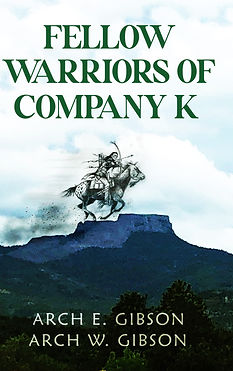
Fellow Warriors of Company K
From Fierce Foes to Fellow Warriors
Disillusioned U.S. Cavalry Major Sam Nabors hopes to retire when he is called to Fort Leavenworth in the post-Civil War West. Guilt-ridden after the murder of his family on their Silver Creek farm in Kansas, Nabors is promoted to colonel and convinced by General Andy Chutte that he is one of few who can lead a mission to retrieve an abandoned cache of gold…before disaffected Confederate marauders steal it to finance a new war. Nabors grudgingly accepts, buying time to resolve his grief and please the general.
Nabors is joined by an unlikely match of Union and Southern officers, the famed all-black Buffalo Soldiers, Comanche and Osage, and remarkable emancipated women of the period. Too late, a supposedly loyal officer is linked to his family’s death…and a whole lot more. A trail of blood and betrayal ensues from New Mexico territory to Silver Creek before Nabors and fellow warriors extract the long-delayed revenge and Nabors can hang up his spurs for good.
Inspiration:
Fellow Warriors
Of Company K
What inspires a writer to write or rewrite someone else’s work? It can be the simple incentive of finishing what someone else started. Such is the case with Fellow Warriors of Company K. I can now say that my Father, Fort Sill-trained World War II artillery officer Arch E. Gibson, has finally published the novel of his passion, the U.S Cavalry in the post-Civil War West…with me as his co-author.
The novel is not about artillery, per se. It was a collaborative effort in the end and took another thirty years after his death in 1996 for me to finish. Our novel focuses on the challenges of a composite cavalry company formed to rescue gold from an abandoned frontier fort (New Mexico) in the tumultuous 1870s. But it is much more than that; duty, honor and sacrifice, yes…amid family and racial hatred, Southern repatriation, Women’s rights, westward expansion, and displacement of First Americans during the post-war period.
Period fiction was Gibson’s passion most of his life; growing up in the small town of Arkansas City, KS, surrounded by frontier family and history. He read voraciously and wrote throughout his life. He penned Company K after completing an illustrious career as an artillery officer, National Guard commander, newspaper reporter, editor, publisher, politician, congressional legislative assistant, and service with the General Services Administration. Retired and manuscript in hand, Gibson found it difficult to land a publisher in the 1990s. Trying to wrap up affairs after a succession of heart attacks, he handed the manuscript to me.
“See what you can do with this.” He died July 12, 1996, in Colorado Springs, CO.
I was well-equipped to do something with the book but was in the middle of my own writing career and a multitude of projects with Texas Instruments. We had collaborated on Blue OP Nine, the Dad’s biographical account of life as a forward observer in the Battle of Bougainville, 1943-44. I would write and self-publish the Bear Kotah series of novels and two historical fiction projects before turning back to Company K in 2024, all the time with certain words from my youth firmly in mind: “You start something, you finish it.”
I started by reviewing Dad’s career and how he had come to write a historical novel. He graduated from the Fort Sill Field Artillery and Officer’s Candidate School in January 1943. He had joined Battery F, 161st Field Artillery, Arkansas City, KS in 1940 and deployed to the Aleutian defense when the war broke out. He was shipped back to attend Fort Sill’s field artillery school in the fall of 1942. He graduated with Class 48 in January 1943. After a short leave he shipped to Hawaii and then to the Americal Division in the South Pacific.
Now a Second Lieutenant, Dad was placed in charge of a 247th Field Artillery forward observation post (OP) atop a 125-foot banyan tree on Bougainville. It was outside the U. S. perimeter overlooking the Torokina River and hills to the northeast. The Army had reinforced the U.S. Marines in pushing the Japanese out of the Empress Augusta Bay area to secure enough land for an air strip. The Japanese Imperial 6th Division artillery launched a counterattack in the pre-dawn hours of March 8, 1944, and continued until the Japanese withdrew March 27. Gibson and his rotating NCO support operated around the clock for ten days directing counterfire on glimmers of enemy cannon flashes from the caves and jungle-covered hills.
Dad had to have help descending the towering post due to exhaustion and temporary loss of eyesight. He would later receive a commendation for providing the Division with the first and most accurate counterfire data. His commendation: “…On the first morning of the enemy artillery shelling Lieutenant Gibson was the first observer to report enemy gun flashes and throughout the remainder of the period his observation post proved to be the most efficient observation post in all the Division… The success of the post was entirely due to the tireless conscientious efforts of Lieutenant Gibson.”
Dad was promoted to First Lieutenant and flew aerial observation missions before volunteering for General Douglas MacArthur’s Philippines operations. He was commanding a flotilla of landing craft by the time the war ended. He returned to the U.S. in August 1945 and was offered a post as artillery instructor at Fort Sill. He passed on that to focus on a growing family at home. Opportunity came again with the Korean War but he had to pass due to medical issues remaining from the South Pacific. He was discharged from federal service but assumed command of the Kansas National Guard unit in our hometown of Arkansas City. He served in that capacity until resigning in 1949 to focus on a civilian career which eventually led well away from home. By 1951 there were seven of us to support, Mom, Patty, me, Roger, Rick, Becki and Ronnie.
Speaking briefly to family prior to his grandson’s U. S. Marine Corps commissioning ceremony, and a month before his death, the elder commended Trent A. Gibson on accomplishments in the First Gulf War, but advised, “In days ahead you will learn that no matter how much you give, or sacrifice, or the honors bestowed…it will never, ever be enough.”
Young Gibson went on to serve the USMC with distinction in numerous roles and the Middle East wars for some 26 years. He passes on his experience and the principles of “one man can make a difference,” in domestic and international speaking and training roles.
